Frequently asked questions
The most common questions on hydraulic cylinder selection, manufacturing ranges, standards, testing and export. If your question is not covered, write to our engineering team.
How do you calculate the push force of a hydraulic cylinder?
Push force is F = P × A: system pressure times piston area. Example: a Ø100 mm bore at 200 bar produces about 157 kN (16 tonnes) of push force. For pull force the rod cross-section is subtracted. Our online configurator calculates this live, together with buckling check and seal recommendation.
What is the difference between single-acting and double-acting hydraulic cylinders?
A single-acting cylinder applies hydraulic pressure in one direction only; the return stroke comes from the load or a spring (common on tippers and lifting platforms). A double-acting cylinder is pressurised in both directions and is used where controlled force is needed in push and pull (construction machinery, presses, industrial machines). HPS manufactures both types in the Ø25–320 mm bore range.
What is a telescopic hydraulic cylinder and when should it be used?
A telescopic cylinder consists of multiple nested stages and delivers a stroke several times its closed length. It is the right choice when installation space is limited but a long stroke is required: tipper trucks, refuse vehicles, mobile elevating platforms. HPS manufactures multi-stage telescopic cylinders with strokes up to 12,600 mm.
What bore, rod and stroke ranges can HPS manufacture?
Bore Ø25–320 mm, rod Ø15–250 mm. Stroke up to 7,000 mm for industrial cylinders (subject to buckling analysis) and up to 12,600 mm for telescopic cylinders. Rated working pressure 200–250 bar; every cylinder is pressure-tested per ISO 10100 at up to 1.5× rated pressure.
Which seal material should be selected for which operating conditions?
Rule of thumb: NBR for standard applications (≤90°C), HNBR where higher temperature resistance is needed (~120°C), polyurethane (PU) for heavy-duty wear resistance at high pressure, FKM for high temperatures and aggressive fluids, PTFE for low friction and high speeds. Final selection is verified by engineering against pressure, temperature and fluid profile; the seal finder on our site does the first screening automatically.
Which standards do HPS hydraulic cylinders comply with?
Design and dimensioning follow ISO 6020-2 and ISO 6022 (high-pressure series), testing follows ISO 10100, system safety ISO 4413, fatigue verification ISO 10771-1. Tube material is DIN 2391 ST52 / EN 10305-1 E355 with EN 10204 3.1 material certification. Mounting types use ISO 6099 coding. The company is ISO 9001:2015 certified, and a manufacturer's EC Declaration of Conformity under Machinery Directive 2006/42/EC is provided on request.
How are cylinders tested before shipment?
Before shipment, every cylinder passes a test-bench pressure test per ISO 10100 at up to 1.5× rated working pressure. The test checks internal and external leakage, full-stroke function and drift (holding). On request, a pressure test report and EN 10204 3.1 material certificates are supplied with the product.
What materials are used for the tube and the piston rod?
Tube: DIN 2391 ST52 / EN 10305-1 E355 steel, honed bore to H8–H9 tolerance. Rod: CK45, or 42CrMo4 where higher strength is required, hard-chrome plated at approximately 30 µm (min. 20 µm). Material certificates are documented per EN 10204 3.1.
How is rod buckling prevented on long-stroke cylinders?
Design includes an Euler buckling analysis: the minimum safe rod diameter is calculated from stroke, pressure and mounting configuration. If inadequate, the solutions are a thicker rod, a larger bore, a stop tube, or a different mounting geometry. The HPS configurator runs this check automatically and suggests alternatives when needed; industrial strokes up to 7,000 mm are validated with this analysis.
Can HPS manufacture from a sample or a technical drawing?
Yes — custom design is one of our core product families. Customer drawings (PDF/DWG/DXF/STEP) go directly into production engineering; without a drawing, we dimension an existing sample cylinder and produce manufacturing drawings by reverse engineering. Process: request → engineering review → approval drawing → prototype → series production. We work from a single prototype up to series quantities.
Which countries does HPS export to, and under which delivery terms?
We export directly to 49 countries on four continents: Europe, the CIS, the Gulf and Middle East, Asia (China, Pakistan), North Africa and the Americas. The customs tariff (HS) code is 8412.21. Delivery terms are agreed per project as EXW, FCA, CIP, CIF or DAP; shipments go by road, sea and air freight.
How does HPS supply OEMs (vehicle and machine manufacturers)?
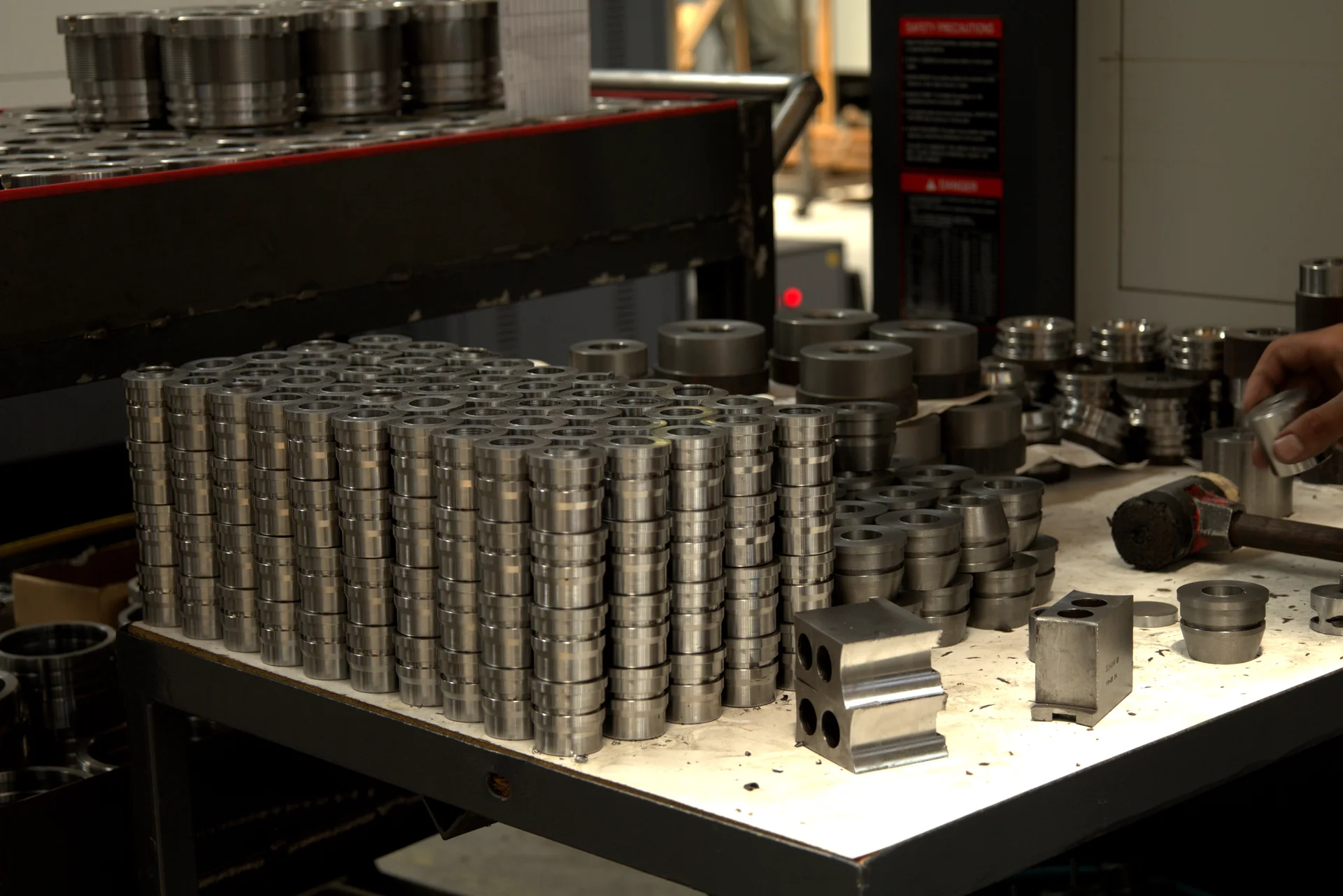
Our core model is direct OEM supply: we produce series cylinders to customer drawings for manufacturers of tippers, refuse vehicles, mobile platforms, forklift attachments, agricultural and construction machinery. This website lists cylinder types and spec tables for 12 sectors; approval drawing + prototype + series delivery schedule are planned per project. Machining, welding, assembly and pressure testing are done in-house on our 20,000 m² site; telescopic stage tubes are hard-chrome plated on our own line.
How do I request a quote (RFQ), and what information is needed?
Use the form on the contact page: cylinder type, bore-rod-stroke, working pressure, mounting style and quantity are enough; a technical drawing (PDF/DWG/DXF/STEP, up to 15 MB) can be attached. A configuration made in the online configurator transfers to the form in one click. Your request is reviewed by the engineering team and answered in writing within 1 business day. Phone/WhatsApp is available for urgent cases.
Is there a minimum order quantity (MOQ)? Do you produce low volumes?
There is no hard MOQ: we produce from single prototypes up to series batches in the hundreds. Low-volume, drawing-specific production is one of our core capabilities; after sample/prototype approval, work moves to series quantities. Quantity directly affects pricing, so stating it in your request gets you the most accurate offer.
Can you produce replacement cylinders to an OEM part number?
Yes. We build construction-machinery and equipment cylinders compatible with OEM dimensions: the part number and basic dimensions (bore-rod-stroke, mounting) are enough; a photo or drawing of the existing cylinder speeds things up. Manufacturer part numbers are cross-matched on request; hard-chrome rod, pressure testing and EN 10204 3.1 material certificate are included.
Which seal brands do you work with?
We supply Kastaş, Gapi, Hallite, Parker, Trelleborg and Merkel; without a specification the HPS standard applies. The material (NBR/PU/HNBR/FKM/PTFE) is selected for operating temperature and pressure; just state your preferred brand in the RFQ.